
INDEX ANNUITY

Why Fixed Indexed Annuities? Understanding Their Unprecedented Popularity
Executive Summary & Quick Take
Fixed Indexed Annuities (FIAs) have surged to the forefront of retirement planning, driving total U.S. retail annuity sales to a historic high of $464.1 billion in 2025, with FIAs capturing an impressive $127.9 billion of that market
The primary driver behind this boom is simple: pre-retirees and retirees are seeking a bridge between low-yielding safe assets and high-volatility stock markets. An FIA delivers 100% principal protection against market downturns through a contractually guaranteed $0\%$ floor, while simultaneously allowing you to capture index-linked growth potential. Coupled with tax-deferred earnings and optional lifetime income riders, FIAs have become the financial vehicle of choice for Americans navigating retirement transition.

The Macro Shifts Behind the FIA Boom
The surge in FIA popularity is not an accident—it is the direct result of significant demographic and macroeconomic shifts:
The “Peak 65” Demographic Surge: Over four million Americans are turning age 65 every year. This historic demographic wave represents millions of investors shifting their primary financial goal from aggressive wealth accumulation to strict asset preservation and income generation.
Stock Market Volatility & Sequence of Returns Risk: A market crash in the early years of retirement can permanently damage a portfolio’s longevity. Retirees are increasingly looking for ways to stay connected to equity growth without risking their principal.
Bond Market Uncertainty: Traditional fixed-income portfolios have struggled to deliver consistent safety and yield during unpredictable interest rate cycles, leading many investors to view FIAs as a modern alternative to bonds.
How Fixed Indexed Annuities Work: The "Ratchet" Effect
Unlike variable annuities (where your principal is directly exposed to stock market drops) or fixed annuities (which pay a single, static interest rate), an FIA offers a hybrid approach.
Your funds are never directly invested in the stock market. Instead, the insurance company uses the returns of an underlying index (such as the S&P 500 or specialized volatility-controlled indices) to determine your interest crediting rate.

The 0% Floor: A One-Way Growth Ratchet
The foundational rule of an FIA is simple: When the market goes up, you can gain; when the market goes down, you lose nothing. Think of an FIA as a financial ratchet mechanism:
The Lock: As the underlying index gains value during favorable market cycles, interest is credited to your contract.
The Reset: At the end of each contract term (typically annually), that earned interest is locked into your account value.
The Protection: If the market declines during the next cycle, your account value does not decline. It simply remains flat ($0\%$ return for that period), protecting both your original principal and all previously locked-in gains.

Mathematical Precision: How Growth is Credited
Insurance carriers use three primary mechanisms to balance upside growth potential with the cost of providing a $0\%$ principal floor
Participation Rate: The percentage of index growth credited to your contract. (Why it matters: If the index grows by $10\%$ and your participation rate is $80\%$, you receive an $8\%$ credit.)
Cap Rate: The maximum ceiling on your return for a given period. (Why it matters: If the index gains $12\%$ but your cap is $6\%$, your credited gain is capped at $6\%$.)
Spread Rate: A fixed percentage subtracted from the total index gain before interest is applied. (Why it matters: If the index rises $10\%$ and your spread is $2\%$, your net return is $8\%$.)
Mathematically, the crediting calculation for a given contract cycle can be represented as:
Note on Index Returns: Index crediting calculations reflect price return only and do not include underlying stock dividends.

Core Benefits Driving Mass Adoption
1. Tax-Deferred Compounding
Unlike CDs, corporate bonds, or high-yield savings accounts that generate taxable income annually, money inside a non-qualified FIA grows on a tax-deferred basis. You pay no taxes on gains until you begin taking withdrawals, allowing your interest to compound faster over time.
Lorem ipsum dolor sit amet, consectetur adipiscing elit. Ut elit tellus, luctus nec ullamcorper mattis, pulvinar dapibus leo.
2. Guaranteed Lifetime Income
Most modern FIAs offer optional Guaranteed Lifetime Withdrawal Benefit (GLWB) riders. These riders establish an “Income Base” that grows by a guaranteed compound rate during your deferral years, providing a predictable paycheck for life—even if your actual account value eventually drops to zero due to longevity.
3. Integrated Health & Care Multipliers
Selected income riders include enhanced payout triggers. For instance, if you become unable to perform two out of six Activities of Daily Living (ADLs) or require qualifying nursing care, these multipliers can double your lifetime income payout for a set timeframe to help absorb healthcare costs..
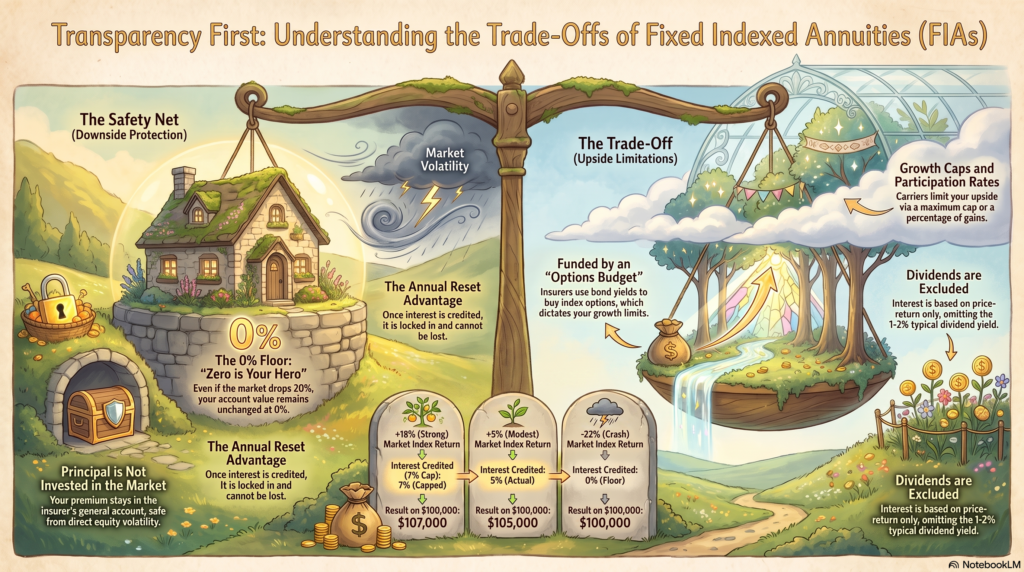
Transparency First: Understanding the Trade-Offs
To determine if an FIA fits into your financial strategy, it is vital to weigh its guarantees against its contractual trade-offs:
0% Floor
You will never lose principal due to market crashes.
Your upside is limited by caps, spreads, or participation rates. You will not capture $100\%$ of a bull market.
Guaranteed Income
Creates a predictable lifetime pension stream.
Optional income riders often carry an annual fee (typically $0.95\%$ to $1.50\%$) deducted from the contract value
Long-Term Protection
Protects your long-term retirement timeline.
Early withdrawals beyond penalty-free limits (usually $10\%$ per year) incur surrender charges during the commitment period.
Frequently Asked Questions
Are Fixed Indexed Annuities safe?
Yes. FIAs are backed by the financial strength and claims-paying ability of the issuing life insurance company. State regulation requires insurance carriers to maintain strict reserve requirements backing every dollar promised to policyholders.
How do FIAs compare to traditional CDs or Bonds?
Certificates of Deposit (CDs) offer fixed, modest returns with FDIC insurance but lack market-linked growth upside. Bonds offer yield, but their underlying market value can fall when interest rates rise. FIAs eliminate market principal loss while offering potentially higher returns linked to stock index performance.
What happens to my money if I die?
If you pass away before annuitizing the contract or starting lifetime withdrawals, your designated beneficiaries receive the full remaining account value (or a guaranteed death benefit specified by your contract) without going through probate.
Disclaimers: Fixed Indexed Annuities are long-term insurance products designed for retirement planning. Guarantees are backed solely by the financial strength and claims-paying ability of the issuing insurance company. Index crediting methods do not directly invest in equities or pay market dividends.